.jpg)


NASA INDIA EXHIBITION - Z504
The Real Curriculum Isn’t in the Syllabus
“Architecture is learned by doing, but understood by experiencing.” Balkrishna Doshi often discussed learning through real experiences. However, architectural education today mostly takes place in studios, briefs, and juries. These are controlled environments that mimic practice but seldom reveal its unpredictability. This is why the NASA India Exhibition Zone 5 is significant. It serves not just as an event, but as a disruption.

Date: 27th - 28th, March, 2026
Hosted by: Z504 BMS College of Architecture, Design and Planning
Venue: BMS College Of Architecture Design And Planning, Basavanagudi, Bengaluru
Over two days, with 650+ delegates, 57+ architectural firms, and participation from 17 colleges, the exhibition did something studios often fail to do: it collapsed the distance between learning architecture and witnessing it in motion. This was not just a collection of sheets and models. It was an ecosystem of overlapping perspectives.
In studios, design is often treated as a finished product, something to be pinned up, judged, and archived. But within the exhibition, design revealed itself as a process under constant negotiation. Professional firms presented work shaped by constraints, clients, and real-world complexities, while student projects reflected experimentation and abstraction. The value was not in comparing the two, but in recognizing the gap and more importantly, understanding how to navigate it.
The structured components - a guest talk by Ar. Sriram Ramakrishnan , 2+ workshops- lippan art by resource person Shwetha S G and creative tool kit by Ar. Rakshith Raj, and a panel discussion with 4 panelists - Ar. Vidya Srikanth, Ar. Sridevi Changali, Ar. Gunjan Das, Ar. Anup Naik did more than add to the schedule. They exposed the frictions that the syllabus tends to smooth over: the role of technology, the pressure of decision-making, and the ambiguity of architectural practice. Conversations shifted from what was designed to why it was designed that way, a shift that rarely happens within conventional academic settings
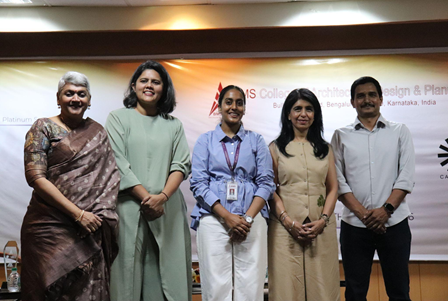
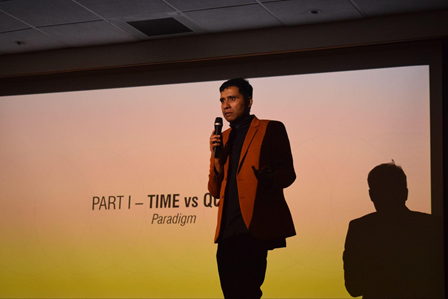
But what truly challenged the idea of a “curriculum” were the informal layers of the exhibition. Student-led stalls, hands-on craft sessions like Lippan art, and performative expressions of themes such as “Architecture Under Pressure” blurred the boundaries between disciplines. They suggested something fundamental: architecture does not operate in isolation. It is shaped as much by culture, material exploration, and interaction as it is by technical knowledge.
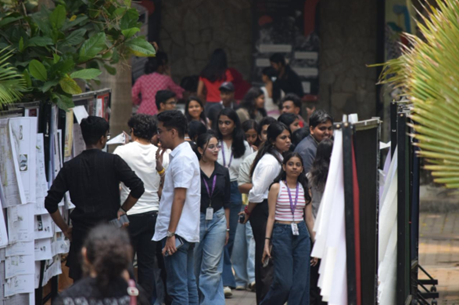
Glimpses of the exhibition and the nexus events
And that is where the limitation of the syllabus becomes evident. A syllabus is designed to structure learning but architecture, as a discipline, resists being structured so neatly. It is fluid, collaborative, and often uncertain. By trying to formalize it too rigidly, education risks producing designers who are technically sound but contextually unprepared.
Exhibitions like this do not simply add value to education, they expose what is missing from it. They create moments where students are not just presenting work, but positioning themselves within a larger architectural discourse. They replace passive learning with active observation, and isolated thinking with collective understanding.
If studios teach us how to design, spaces like these teach us how architecture exists. And perhaps that is the uncomfortable but necessary realization that the most critical parts of architectural education are not found within the syllabus but in the spaces where the syllabus no longer applies.
Credits
Dr Vidya Srikanth - Director
BMS College Of Architecture Design And Planning
Ar. Rakshith Raj - NASA Coordinator
BMS College Of Architecture Design And Planning
Co-ordinators
Prakshi Jain
Z504 Unit Secretary
Brindha BK
Z504 Unit Designee


Comments